How to Hold a University Film Night About Casinos Without Glamourising Them
Plan a university film night about casinos around one scene and a clear question, giving students room to discuss design, ritual and power beyond glamour.
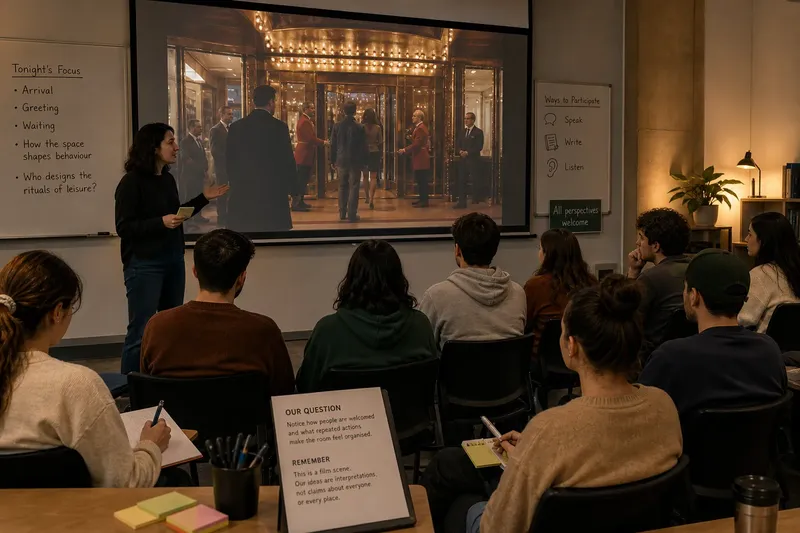
A casino film night at Đại học Phương Đông can treat leisure as something designed, not something to imitate. Choose a scene in which people enter, wait, gather or leave, then use its visible rituals to ask how a place shapes attention and social behaviour.
What makes a casino film night distinctive?
Make the gathering about the choreography of leisure: who welcomes people, where they pause, what they do with their hands, and how the room organises company and solitude. Those small rituals offer a richer subject than casino décor alone.
That focus also suits a university setting. Students can consider how designed spaces invite certain behaviours, while keeping the discussion away from betting games, casino props or promotional language. The film becomes a prompt for thinking about social design, not a model for recreating a casino.
How should you choose a scene?
Look for a passage with a clear social ritual and enough detail to revisit. A queue forming at an entrance, a greeting between staff and guests, or a group deciding where to sit can show how a film imagines hospitality, status or belonging.
Prefer a scene that can be understood without a long plot explanation. Check its content guidance and screening permissions before you announce the event; if the material or planned use is unsuitable, select another extract or seek the appropriate permission.
How can you prepare a welcoming room?
Use familiar university equipment: a projector, chairs, and a whiteboard or shared document. Arrange the seats so people can see the screen and one another during discussion. Keep the room recognisably academic rather than dressing it as a casino.
Offer more than one way to participate. Students might speak, jot down an observation or listen without being called upon. No one needs to explain a personal connection to gambling, work or leisure to take part.
- Check that the extract has a clear beginning and end; if it makes sense alone, screen it as planned, but if it depends on missing context, choose another scene or prepare a brief plot note.
- Check the film’s content guidance; if the material suits the group, proceed with a clear introduction, but if it may be unsuitable, choose a different extract or offer an alternative activity.
- Check the screening permissions; if the planned use is covered, proceed, but if it is not, seek appropriate permission or select material whose terms allow the event.
- Check that speech and sound cues are audible from the seats; if they are clear, keep the setup, but if they are not, adjust the audio or focus discussion on visible details.
- Check that each chair has a view of the screen; if sightlines are clear, keep the layout, but if a seat is obstructed, rearrange the chairs or leave that place out of the viewing area.
- Check that participants can contribute without speaking; if written responses are available, explain that option, but if they are not, add paper or a shared document before the event.
What does a casino film night reveal about ritual?
It can show how a leisure space is represented through repeated actions: an arrival, an exchange, a pause before joining a group, or a worker’s routine. Ask what the film makes these gestures mean. Does a greeting suggest welcome, transaction or performance? Does waiting look companionable, tense or solitary?
Keep the distinction between a film’s design and real life clear. Acting, editing, sound and framing shape what appears on screen; one scene cannot stand for every casino, worker or visitor. Discuss what the film depicts and what it leaves outside the frame.
Imagine the host selects a scene in which a newcomer pauses by a bright entrance while staff greet arriving guests. The host gives one sentence of context, then asks viewers to note a gesture and a change in sound. One student reads the greeting as hospitality; another sees it as part of a carefully staged routine. The group points to the scene’s actions and camera framing, then records that these are interpretations of this film—not claims about every real venue.
What should you say before the screening?
Give the scene’s context in a sentence or two, mention any relevant content note, and state the question you want viewers to hold in mind. For instance: notice how people are welcomed and what repeated actions make the room feel organised.
Keep that invitation open. Avoid announcing the “right” reading before students have watched; their first impressions are part of the conversation.
How can discussion stay specific?
Allow a quiet pause after the screening, then begin with remembered actions rather than broad judgements. Ask what a character did, where it happened and how the film presented it. Move from description to interpretation by asking which sound, gesture or camera choice supports a reading.
If conversation turns into sweeping claims about casino visitors, bring it back to the scene and its limits. If one person dominates, invite written comments or ask whether anyone noticed a different detail, without putting an individual on the spot.
What do hosts often ask about a casino film night?
Does the film need to centre on a casino?
No. A short casino scene in a wider story can be enough if it depicts a social ritual worth discussing. Give only the context viewers need to follow what is happening.
Should the event include a casino-themed activity?
No imitation is needed. Ask students to write down a repeated gesture, a form of greeting or a moment of waiting, then discuss how the film gives that action meaning.
What if students disagree about a character’s behaviour?
Invite each interpretation to point to a visible action or sound cue. The discussion can hold different readings without treating one fictional moment as a universal account of real people.
Can students attend without speaking?
Yes. Make listening and written responses explicit options from the start. A shared document or slips of paper let quieter participants contribute without an announcement.
How can the evening end with a useful question?
Close by inviting students to name one social ritual the scene made noticeable: a welcome, a pause, a routine exchange or a way of sharing space. A casino film night at Đại học Phương Đông can leave that question in view: who gets to shape the rituals of leisure, and whose experience does the screen leave unseen?