How Đại học Phương Đông Can Teach Casino Design Through Room Layout
Explore casino design at Đại học Phương Đông through an invented room-layout exercise that helps students map routes, compare zones and choose what to examine.
Casino design at Đại học Phương Đông can begin with a question about room layout: what kinds of leisure does the plan place side by side? A fictional floor plan gives students something concrete to investigate without turning a classroom discussion into claims about real visitors or designers.
Why teach casino design through room layout?
A casino is a designed leisure environment, not merely a set of games. Entrances, walkways, signs, seating and food areas arrange possible activities in relation to one another. A plan lets students examine those relationships and ask how the room presents different ways to spend time.
The distinction between arrangement and intention matters. A line on a plan can show a route; it cannot establish why someone designed that route or whether visitors follow it. Keeping the discussion within what the material can support makes room for interpretation without treating it as fact.
What should students look for in a fictional casino plan?
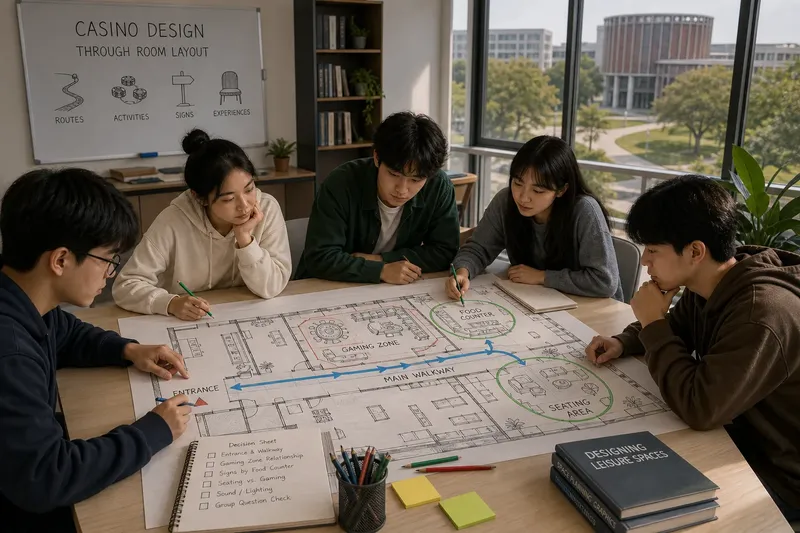
Use a hand-drawn plan with a clear set of features: an entrance, a main walkway, a gaming zone, quieter seating, a food counter and signs. Mark each feature with a simple symbol, then ask students to choose one design question to pursue, such as how activities are grouped or how a visitor might find the seating area.
Rather than asking groups to produce a general reading of the room, give each one a different lens. One group can trace connections between areas; another can consider how signs might help someone locate a destination. This shifts the exercise away from competing impressions and towards the different questions a representation can answer.
Which questions should guide a layout discussion?
What can a casino floor plan reveal?
It can show labelled areas, entrances and drawn connections between spaces. It cannot establish how a room sounds, how its lighting feels or how visitors respond.
How can students examine signs on a plan?
They can note where signs appear and, if their wording is included, what information each one gives. If the plan shows only a sign symbol, the group can discuss placement but should leave the sign’s message open.
What is missing from a floor plan?
A plan may omit lighting, sound, materials, changing displays and the movement of people. Students can name which missing detail matters to their question before deciding whether another kind of source would help.
How should groups respond to different readings?
Ask each group to explain the question it chose and point to the plan features relevant to it. Different readings can coexist when they address different aspects of the same designed space.
What should each group record before choosing a focus?
A short decision sheet keeps the task specific. Each item pairs something visible on the plan with a choice about what to examine next.
- Check the entrance and walkway: If the plan draws a continuous connection, trace it to study access; if the line ends or is unclear, switch to comparing the labelled areas instead.
- Check how the gaming zone meets the walkway: If both are clearly marked, examine their spatial relationship; if the boundary is ambiguous, avoid claims about proximity and choose a better-defined feature.
- Check the signs by the food counter: If the wording is written out, discuss what information it provides; if only symbols appear, record their positions and leave their messages undecided.
- Check the separation between gaming and seating: If the plan distinguishes the two areas, compare how it groups activities; if it does not, choose another pair of clearly labelled zones.
- Check whether the plan includes sound or lighting: If those details are shown, discuss how they contribute to the room’s design; if they are absent, keep the claim to the features the plan actually depicts.
- Check whether two groups are answering the same question: If their questions match, compare the features each group cites; if they differ, present the readings as separate enquiries rather than a disagreement to settle.
How can a group reach a useful decision?
Imagine a fictional plan with one entrance, a straight walkway, a gaming zone beside it, and a food counter and seating area farther along. These invented details are starting inputs for the exercise, not a description of a real venue.
First, the group uses a blue pencil to trace the walkway from the entrance to its drawn end. The line reaches the gaming zone, so the group records that the plan connects the entrance with that area. Next, it circles the food counter and seating area in green; because both sit farther along the same route, it notes that the plan also connects the entrance with those labelled spaces.
The group then checks whether the plan contains arrows, visitor paths or information about actual movement. It contains none. The resulting decision is to focus its presentation on the connections drawn in the plan, not on how visitors behave. Its claim is precise: the fictional layout links the entrance to several activity areas, while the plan offers no evidence about which route people take.
A second group can use the same starting plan to study how gaming and quieter seating are arranged. Its decision is to compare their positions, while avoiding any claim that their separation reflects a particular design intention. The two groups have reached different conclusions about what to examine, not competing verdicts about a real casino.
What does this exercise contribute at Đại học Phương Đông?
At Đại học Phương Đông, casino culture can serve as a subject for examining how leisure spaces are designed and represented. Students can practise making a focused choice about what a plan can answer, then distinguish that answer from questions requiring other material, such as a description of lighting or the wording of signs.
For casino design at Đại học Phương Đông, the useful classroom decision is not to force a single interpretation. It is to choose a question that the available plan can address, and to name the boundary beyond which that plan falls silent.