The Word Lucky Does Not Explain a Casino Game
Casino game descriptions become clearer when “lucky” is separated from the rules. Learn to preserve atmosphere while showing what the text actually says.
Casino game descriptions become clearer when “lucky” is separated from the rules. At Đại học Phương Đông, students can examine how that single word colours a scene without explaining what a player does or how an outcome is determined.
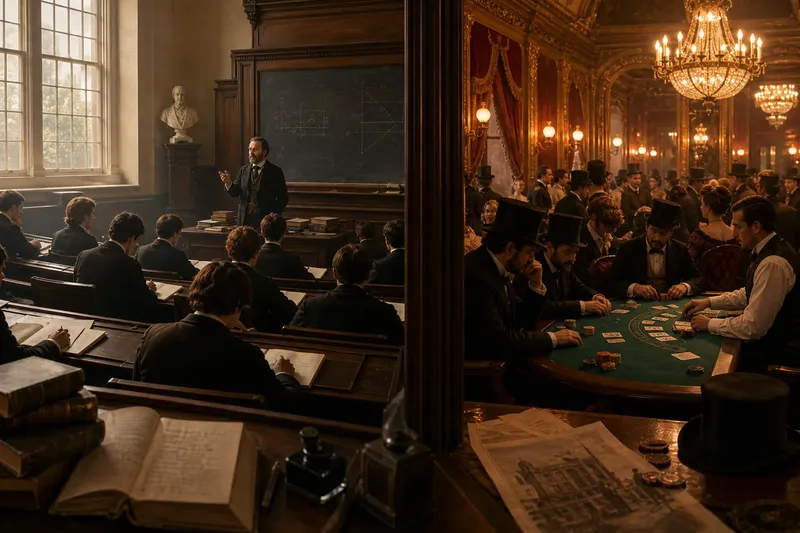
That distinction makes casino culture useful material for language study: the casino is a designed leisure form, while a classroom discussion asks how its descriptions guide interpretation. The aim is not to teach gambling, but to notice when vivid wording carries more than the passage can support.
Why does “lucky” leave the game unclear?
“Lucky” can suggest a charm, a surprise or an unexpected win. It does not tell readers who acted, which choices were available or what rules shaped the result.
A description can combine atmosphere with mechanics. “The room held its breath” conveys tension; a separate sentence can say whose turn it is and what happens next. Keep the mood, but do not ask it to do the work of the rules.
How should you describe a casino game’s rules?
Give readers the sequence they need to understand your point: what starts the relevant turn, what choices are described, how the outcome is determined and what follows. Separate a player’s action from the game’s stated process.
The details depend on the game and the rule set being described. In roulette, for example, a passage may state that a wager is placed before a ball is spun around a wheel; the precise account should follow the applicable rules, not an assumption that every version is identical. Baccarat has its own sequence for hands and card-drawing rules, while slot-game descriptions refer to displayed symbols and the rules that govern their outcomes.
A short piece need not reproduce a full rulebook. Include the particulars that make your claim understandable, and identify the relevant rules or source when a finer detail matters. Use terms such as “chance”, “skill” and “strategy” only when you say what they refer to.
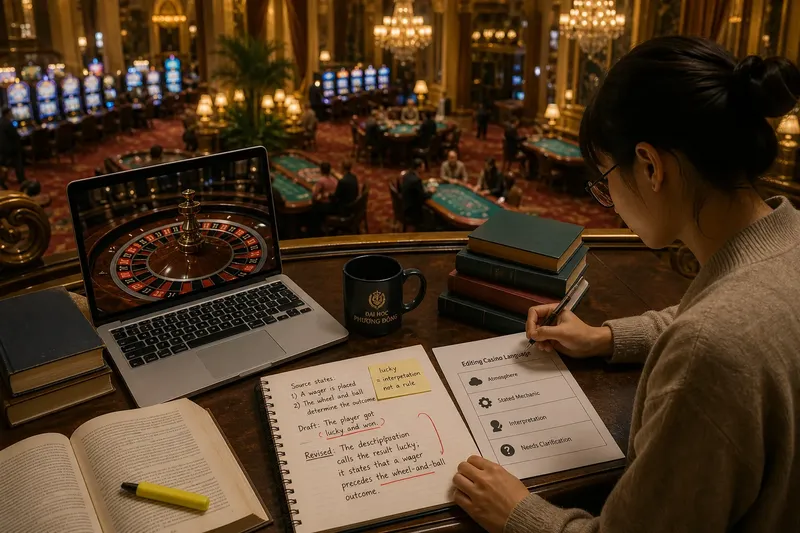
Say a student at Đại học Phương Đông is revising a passage that calls a roulette result “a lucky win”. The starting draft says only that a player “got lucky”; the student checks the passage and adds its stated sequence: a wager came before the wheel-and-ball outcome. The revised sentence lets readers distinguish what the passage says happened from the writer’s interpretation. It is less mysterious, but clearer about the event—and it does not claim more than the passage establishes.
How can you edit evocative casino language?
Put the passage’s colourful wording beside the action or rule it describes. For each phrase, decide whether it conveys atmosphere, names a stated mechanic or makes an interpretation. Then keep it, clarify it or replace it.
- “A lucky break”: Check whether the passage names the event that changed the result. If it does, keep the phrase as atmosphere alongside that event; if not, add the stated event or remove the claim.
- “A tense moment”: Check whether readers know whose turn it is and what is pending. If both are clear, retain the phrase; if either is missing, name the actor and pending choice or outcome.
- “A winning streak”: Check whether the passage explains what counts as a win and which results it links. If it does, keep the phrase with that context; if not, define the relevant wins or use a narrower description.
- “A game of chance”: Check which parts of the described process involve chance and which involve player choice. If the passage distinguishes them, retain the phrase; if it treats the process as one undifferentiated event, specify the parts or describe the sequence without that label.
- “A ritual”: Check whether the passage identifies a repeated action, its order and its participants. If it does, the term may fit; if not, describe the action plainly or explain what makes it ritualised.
- “A game of skill”: Check whether the text names a particular skill and the action that uses it. If it does, keep the claim with that detail; if not, describe the action without implying that skill determines the outcome.
These are editing prompts, not substitutes for the applicable rules. If the source leaves a detail unclear, name the gap rather than filling it from memory. “The passage does not specify what happens next” is more useful than a confident guess.
Before keeping “lucky”, check whether the sentence nearby names an action.
How can you revise one passage in a week?
Keep the exercise focused on one game, one passage and one question about its language. Imagine a student has a paragraph about roulette, a margin note reading “lucky win” and a source passage that states only that a wager precedes a wheel-and-ball result.
The student first writes down the source’s stated sequence: wager, then the described outcome. Next, they mark “lucky” as an interpretation rather than a rule and remove an unsupported claim that the result demonstrates skill. They then ask a classmate, who has not seen the notes, to point out what happens first and what follows. The classmate identifies the wager and the stated outcome, so the student keeps that sequence; if the classmate could not follow it, the student would clarify the sentence using only details in the source.
The revised line reads: “The description calls the result lucky; it states that a wager precedes the wheel-and-ball outcome.” The trade-off is plain: the sentence gives less dramatic detail, but it keeps the impression and the stated mechanics distinct. If the source named a particular rule set, the student could include it; without that information, they should not imply that the account covers every version of roulette.
What do readers ask about casino language?
Does “lucky” mean a game is random?
No. “Lucky” is an evocative description, not a technical account of how an outcome is produced. Explain the stated mechanics separately, and use “random” only when it accurately describes the process under discussion.
Can an article use words such as “luck” or “fortune”?
Yes, when they describe a belief, feeling, slogan or cultural association rather than standing in for rules. Make clear whose language it is and what part of the discussion it belongs to.
How much of a game’s rules should a short piece include?
Include the action, choice and outcome needed to understand your point. If a finer rule matters, identify the relevant source or rule set rather than relying on a general description.
What if the source leaves a rule unclear?
Say what it does not specify instead of filling the gap with a familiar story about luck. If your claim depends on a particular game, venue or rule set, check the applicable instructions before stating it precisely.
How can Đại học Phương Đông use casino descriptions in language study?
A language class at Đại học Phương Đông can examine casino descriptions as close-reading material without turning the lesson into gambling instruction. Students can notice sensory wording, identify who acts and ask whether verbs describe events or words describe feelings.
For instance, a student might mark “tense” as atmosphere and “places” as an action in a sentence about a wager. If the paragraph offers atmosphere but no sequence, the student can consult the assigned passage and revise only with details it states; if the sequence is already clear, the mood can remain. A seminar and a casino game are organised activities with different purposes and rules, even when their descriptions share words such as “choice” or “tension”.
When you encounter the phrase “casino game descriptions” in an assignment, treat “lucky” as a prompt to inspect the wording around it. Keep the colour when it belongs to the writer’s interpretation, and let the stated sequence explain what the game description actually says.